


Click here to visit the website of the exhition
During the opening week of the Venice Biennale, a room at the Hotel Metropole becomes the site of an exhibition by Bracha L. Ettinger.
Bracha. The Room Is Shared transforms the room where Sigmund Freud partly wrote The Interpretation of Dreams between 1895 and 1899, into a space of painting, slow looking, psychoanalysis, resonance, and shared presence.
Curator Carolyn Christov-Bakargiev comments, “In a time saturated by noise and speed, Bracha L. Ettinger’s painting asks us to slow down and to feel-with rather than look-at. The room becomes a shared psychic space where subjectivity is not isolated, but co-emerges through vulnerability, care, and attention. Here, art is not spectacle; it is an act of what she calls ‘borderlinking’.”
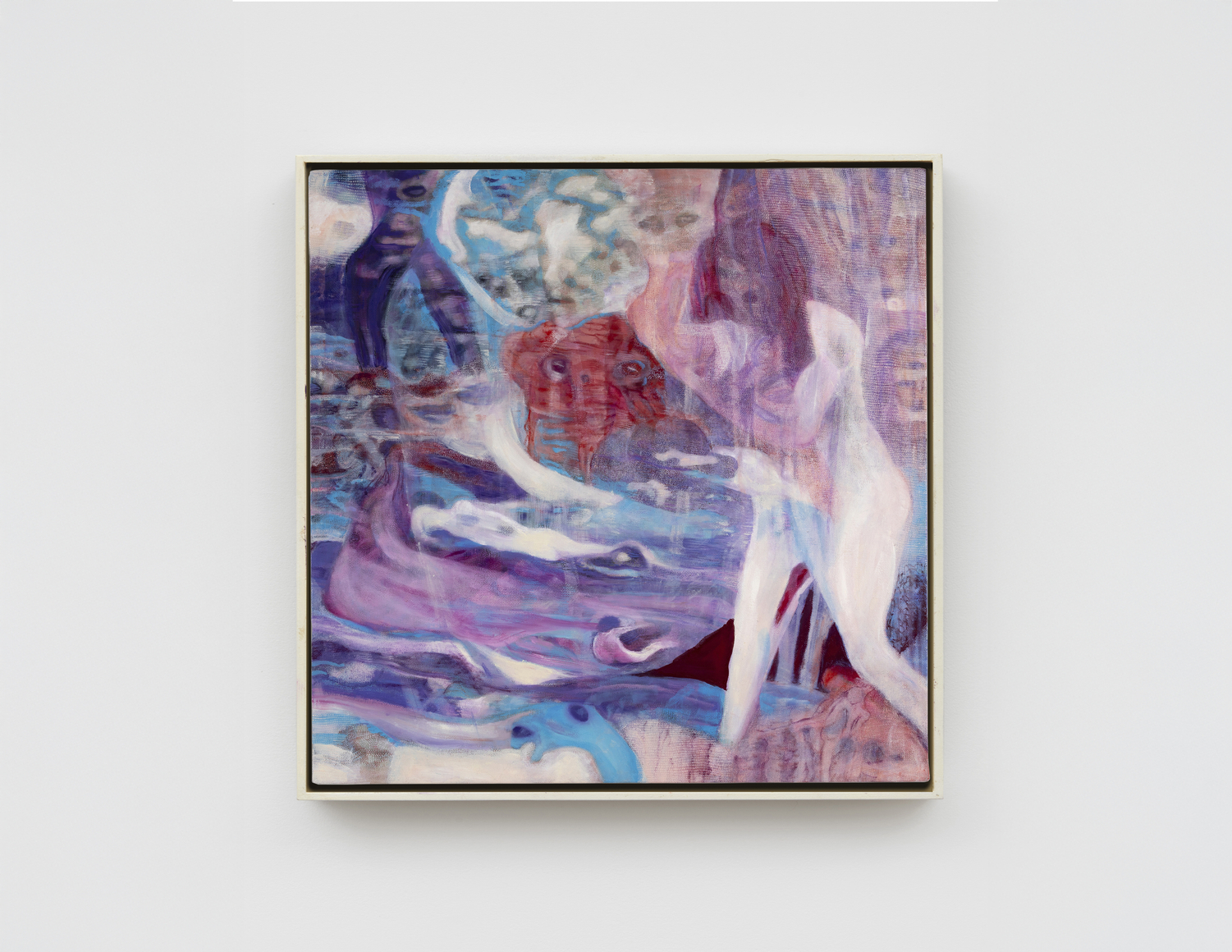
Seven paintings made between 2006 and 2025 are installed within the lived Venetian atmosphere of the historic hotel room. The exhibition unfolds over seven days — the same number as the seven paintings — creating a quiet correspondence between duration and image, time and attention. Veils of mauve, deep red-purple, and milky white release spectral faces and trembling forms that surface and recede as the viewer gazes. Several rare video works premiere in this exhibition and accompany the paintings, extending the artist’s language of layering into moving image, where cinematic time becomes another membrane through which memory and resonance unfold.
This is arguably the smallest exhibition in Venice and, due to limited capacity, booking is essential and open to everyone. Details of how to book and attend in person in Venice will be released on 15 April, 2026. Every thirty minutes, from Monday 4 May to Sunday 10 May, small groups will be guided from the hotel lobby entrance through the exhibition (see below for hours.)
The exhibition also includes an installation of seashells and St. Mary’s Milk thistle. The thistle refers to the legend of a plant in the desert, said to have been grown thanks to drops of the Virgin Mary’s milk while nursing the Infant. Long associated with protection and medicinal plants, it becomes a quiet emblem of nourishment and healing. Placed among shells shaped by tide and time, the installation deepens the sense of the room as a resonant, womb-like space. The encounter becomes one of proximity, echoing the intimacy of a psychoanalytic chamber while offering a contemporary feminist rethinking of subjectivity.
The artist’s famous theory of the “Matrixial” proposes that subjectivity begins not through traumatic separation at birth, as Freud believed, but in shared prenatal relations. In Venice, this concept becomes spatial: viewers enter into what Bracha L. Ettinger calls a “borderspace” that is neither entirely theirs nor entirely the artist’s. For the artist, painting becomes an ethical gesture of “borderlinking” and “co-emergence” in a fractured world.
“Her work, deeply marked by the personal history of her parents, survivors of the Holocaust, emerges in the second half of the twentieth century, a period in which much modern European painting developed in response to individual and collective pain,” says Christov-Bakargiev. “Drawing on both her family heritage and the history of art, she explores notions of generational transmission, trauma, amnesia and collective memories. Bracha L. Ettinger’s theoretical publications in the fields of aesthetics and psychoanalysis have widely influenced feminist thinking about art since the 1980s, as well as the work of many artists today dealing in the world today with the personal impact of colonial violence. Her thinking on the intimate sonority of art resonates with Koyo Kouoh’s theme of this year’s Biennale.”
The Hotel Metropole — with its layered history as a girls’ orphanage from the fourteenth century, music school, hotel from the end of eighteenth century, and military hospital during the Second World War — acts as a matrixial partner in the exhibition. As owner Gloria Beggiato reflects, the Hotel Metropole “has long welcomed artists, writers, musicians and thinkers from around the world. Its walls hold their stories, and we are proud to continue this cultural tradition by hosting projects that bring art into direct dialogue with history.”
Situated away from the fray of the Biennale, Bracha. The Room Is Shared offers a pause — a protected space for reflection during an otherwise accelerated week. In relation to this exhibition, Bracha L. Ettinger poetically states:
An angel is needed to attend to the pain and the beauty of the world in tragic moments, to reorient us toward a humanised future without ignoring the agony. I call her angel of carriance. Her matrice is now endlessly bleeding. In our matrixial sphere I hear your silence whispering, through the other, through the air, through the water, asking me to breathe with-in-for you. Depth to depth resonates. In metramorphic transformation along our shareable subreal transjective strings, co-breathing is co-birthing in com-passion.